How Long to Build a Custom Home: 7 Essential Stages, Best Case
How long to build a custom home on Cape Cod, honestly? Plan on somewhere between eighteen months and three years from first conversation to move-in — and note that construction itself is the smaller half of that. The part people underestimate is everything that happens before a shovel moves.
Below is the sequence broken into seven stages, with what governs the duration of each. Best case at every stage is quoted where it is realistic, because knowing which stages can compress and which cannot is more useful than a single number.
In this guide
- How long to build a custom home, stage by stage
- What can be compressed, and what cannot
- The Cape season problem
- Where schedules actually slip
How long to build a custom home, stage by stage
Stage 1 — Feasibility and site due diligence
Survey, soil and groundwater evaluation, confirmation of coverage and setbacks, septic siting, wetland and flood-zone determination. Weeks, not months, if the parcel is straightforward.
Skipping this stage does not save time. It relocates the delay to a more expensive point later, usually after a design exists that the site will not accommodate.
Stage 2 — Design
Concept through construction documents. Several months is typical, and the variable is almost never the designer’s speed — it is decision latency on the owner’s side. Every round of “let us look at one more option” is real calendar.
Owners who know what they want and decide promptly routinely finish this stage in half the time of owners who are still exploring. That is the single largest lever you personally control.
Stage 3 — Permitting and review
The building permit is the predictable part. What extends this stage is everything alongside it: Board of Health for septic, Conservation Commission if you are within jurisdiction of a wetland or coastal bank, a historic district committee in the six Old King’s Highway towns, and zoning relief if you need a variance.
Conservation review is the usual long pole — a Notice of Intent runs on a hearing calendar with abutter notification, not on a counter. A parcel needing conservation and historic review can spend longer in this stage than in framing.

Stage 4 — Sitework and foundation
Clearing, excavation, footings, foundation, backfill, and the septic system. Weeks under normal conditions. Ledge, a high water table, a mounded septic design, or difficult access can each extend it substantially, which is why Stage 1 matters.
Stage 5 — Framing, roof, and weathertight
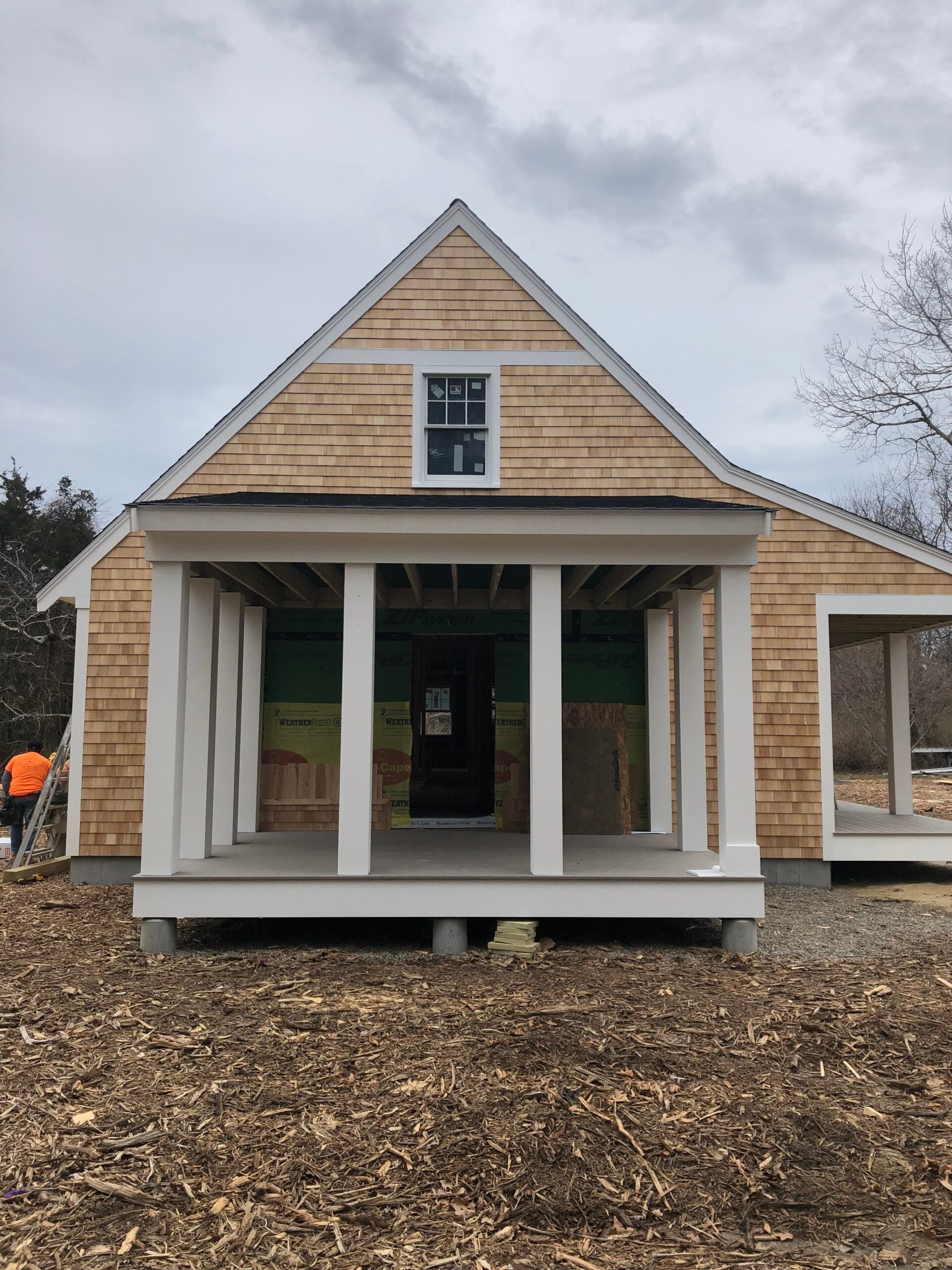
The stage that looks like progress. The house goes from a foundation to a recognizable building quickly, and owners tend to recalibrate their expectations upward right here — just before the longest stage begins.
Getting weathertight before winter is the milestone that governs the rest of the schedule on the Cape. A build that reaches it in November proceeds all winter indoors. One that misses it waits.
Stage 6 — Mechanical, insulation, and interior finish
The longest stage, and the one that feels slowest because visible change slows down. Plumbing, electrical, HVAC rough-in, inspections, insulation and air sealing, drywall, trim, cabinetry, tile, flooring, paint, fixtures — each largely sequential, each dependent on the trade before it.
This is where long-lead materials do their damage. Windows and custom cabinetry ordered late will stall a site that is otherwise ready, and no amount of crew will fix it. Energy-code compliance is also verified around here — the state framework is at Massachusetts Building Energy Codes, and testing is covered in our blower door guide.
Stage 7 — Punch list and occupancy
Final inspections, certificate of occupancy, exterior finishing, landscaping, and the punch list. Weeks. It reliably takes longer than anyone expects, because the remaining items are small, scattered, and each needs a different trade to make a trip for it.
What can be compressed, and what cannot
Compressible: design, if you decide quickly. Selections, if you make them early. Material lead times, if you order ahead of need rather than ahead of installation.
Not compressible: concrete cure times. Inspection scheduling. Hearing calendars. Abutter notification periods. Manufacturing lead times once an order is placed. Adding people to a site does not shorten any of these, and on a small residential site it can lengthen them.
The practical consequence is that almost all genuine schedule savings are available before construction starts, and almost none after. That is the opposite of where most owners apply pressure.
The Cape season problem
Two seasonal effects shape the calendar here. Exterior work wants April to November, and nearly every second-home owner wants their project finished before summer — which oversubscribes spring and leaves the winter months comparatively open.
The scheduling implication is counterintuitive: starting design and permitting in autumn, so that sitework can begin as soon as the ground allows, produces a materially earlier finish than starting the whole process in spring. The parcel questions in our Massachusetts building process guide are the right place to begin.
Where schedules actually slip
- Owner decisions. The most common cause by a wide margin, and the least discussed.
- Change orders mid-build. A change during finish work can unwind completed trades and re-queue several of them.
- Site conditions found late. Ledge, groundwater, unrecorded fill — cheap to discover in Stage 1, expensive in Stage 4.
- Long-lead items ordered on the wrong schedule. Order dates, not install dates, are what to track.
- Permitting treated as a formality. Budgeting weeks for a process that runs on hearing calendars is how an entire construction season gets missed.
Further scheduling detail lives in the FAQ.
Custom Crafted Homes has run this sequence on Cape Cod since 1974 — second-generation builders, third generation here — across all 15 Cape Cod towns, out to Eastham and the Outer Cape. We would rather give you an honest date for your actual site than a comfortable one that slips. Our custom home building page shows how we run these. Call (508) 619-7909 or tell us about the site. We respond within one business day.
Custom Crafted Homes is a family-owned custom home builder and remodeling contractor based in Dennis, MA, serving all 15 Cape Cod towns since 1974. Fully licensed and insured — MA Construction Supervisor License #CS-074943, Home Improvement Contractor Registration #169552.